

Video Game Backgrounds: How Studios Design Them in 2026
Players rarely praise a good background - and that is exactly the point. When the environment art does its job, all the attention goes to the characters, the board, or the action, while the scene quietly carries mood, story, and navigation cues. When it fails, players feel that something is off even if they cannot name it: the board is hard to read, the room feels flat, the level looks like a stock photo.
This guide breaks down how studios approach video game backgrounds in 2026: the main types, what separates a working background from a pretty picture, the production pipeline, genre conventions, and what this work costs. It draws on our own production experience across match-3, merge, casual, and midcore titles - the same discipline we sell as game background design services.
Key takeaways:
- A game background is any environment layer behind interactive elements: location scenes, board backdrops, meta rooms, loading screens.
- Readability beats beauty: contrast peaks stay reserved for gameplay, detail lives at the edges.
- Production runs through six gates from brief to layered PSD, with a review at each one.
- Layered delivery is what makes seasonal reskins cheap - one scene serves years of live-ops.
- A casual 2D scene costs $300-1,500 and takes 3-7 working days; batches lower the per-scene price.
What Counts as a Video Game Background
A background is any environment layer that sits behind interactive elements. That definition is wider than it sounds. In a platformer it is the parallax stack behind the level geometry. In a match-3 game it is the backdrop under the board. In a merge or decoration game the background IS the core meta content: rooms and gardens the player unlocks piece by piece. And in almost every genre the family also includes loading screens, splash art, and map screens.
What unites all of them is a shared constraint: the background must support gameplay reading, not compete with it. Game background design is composition under restrictions - camera angle, safe zones, UI overlays, and the color budget left over after gameplay objects take their share.
The Main Types of Game Backgrounds
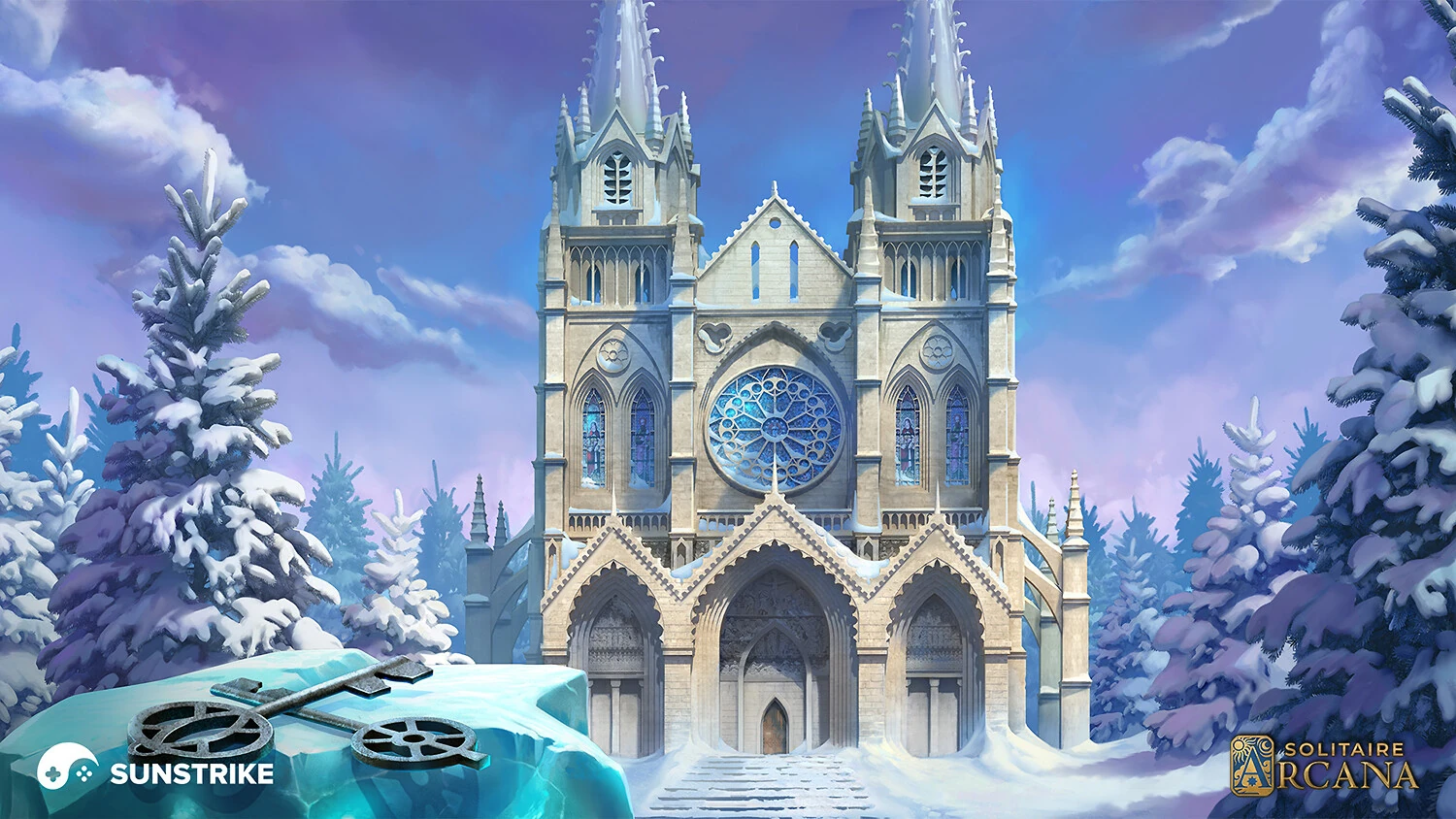
Full-screen location backgrounds
The classic format: a complete painted scene that fills the screen behind gameplay. Card games, hidden-object titles, narrative games, and slots all live on these. The composition usually keeps a calm center or a clear stage area where gameplay elements sit, with detail pushed toward the edges.
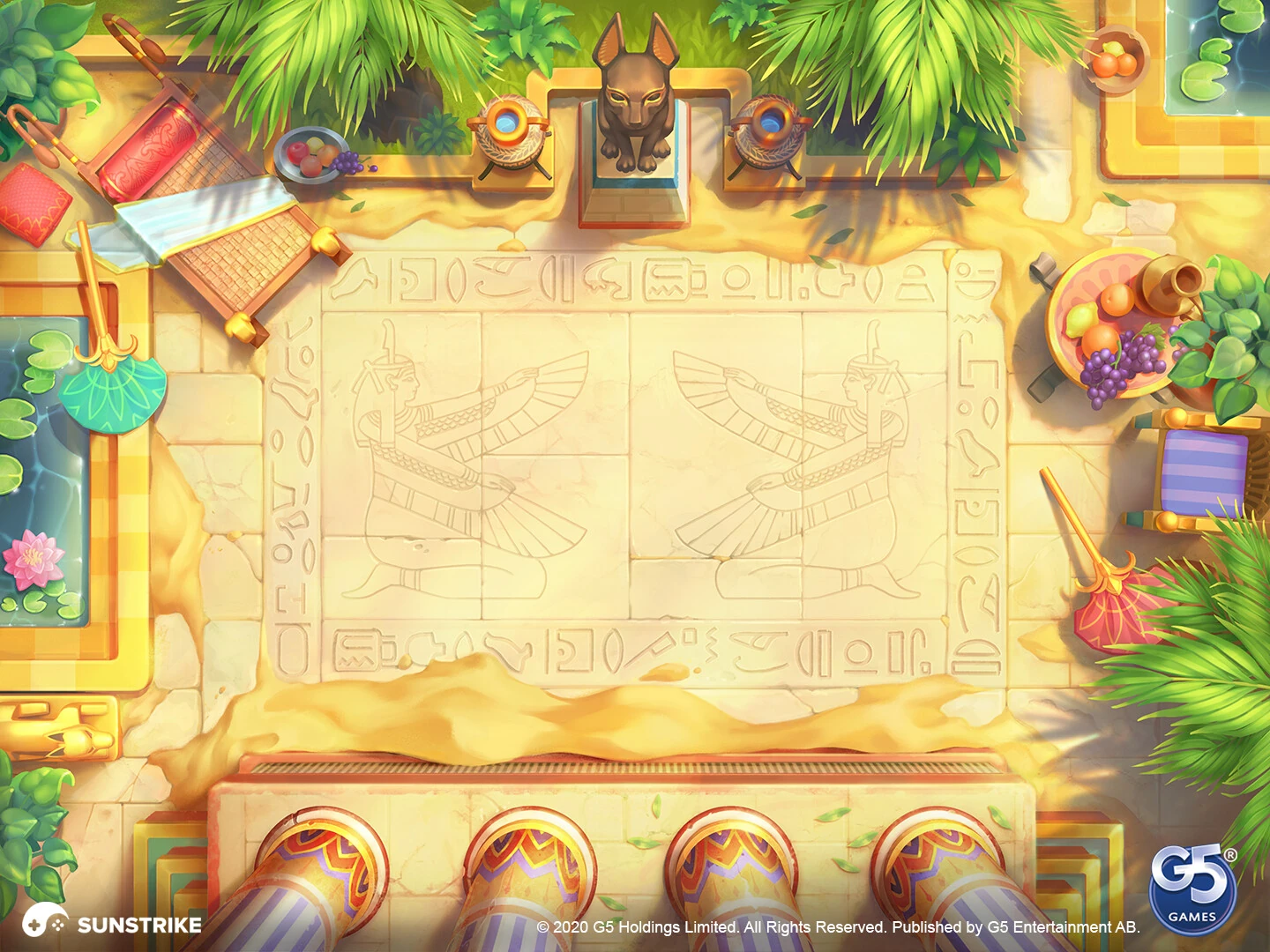
Board backdrops for match-3 and puzzle games
Here the background occupies the space around and beneath a grid that takes up most of the screen. The craft is in restraint: the backdrop must read as a place - an Egyptian courtyard, a garden terrace - through a narrow frame of visible area, without ever stealing contrast from the tiles.
Isometric scenes and meta-decor
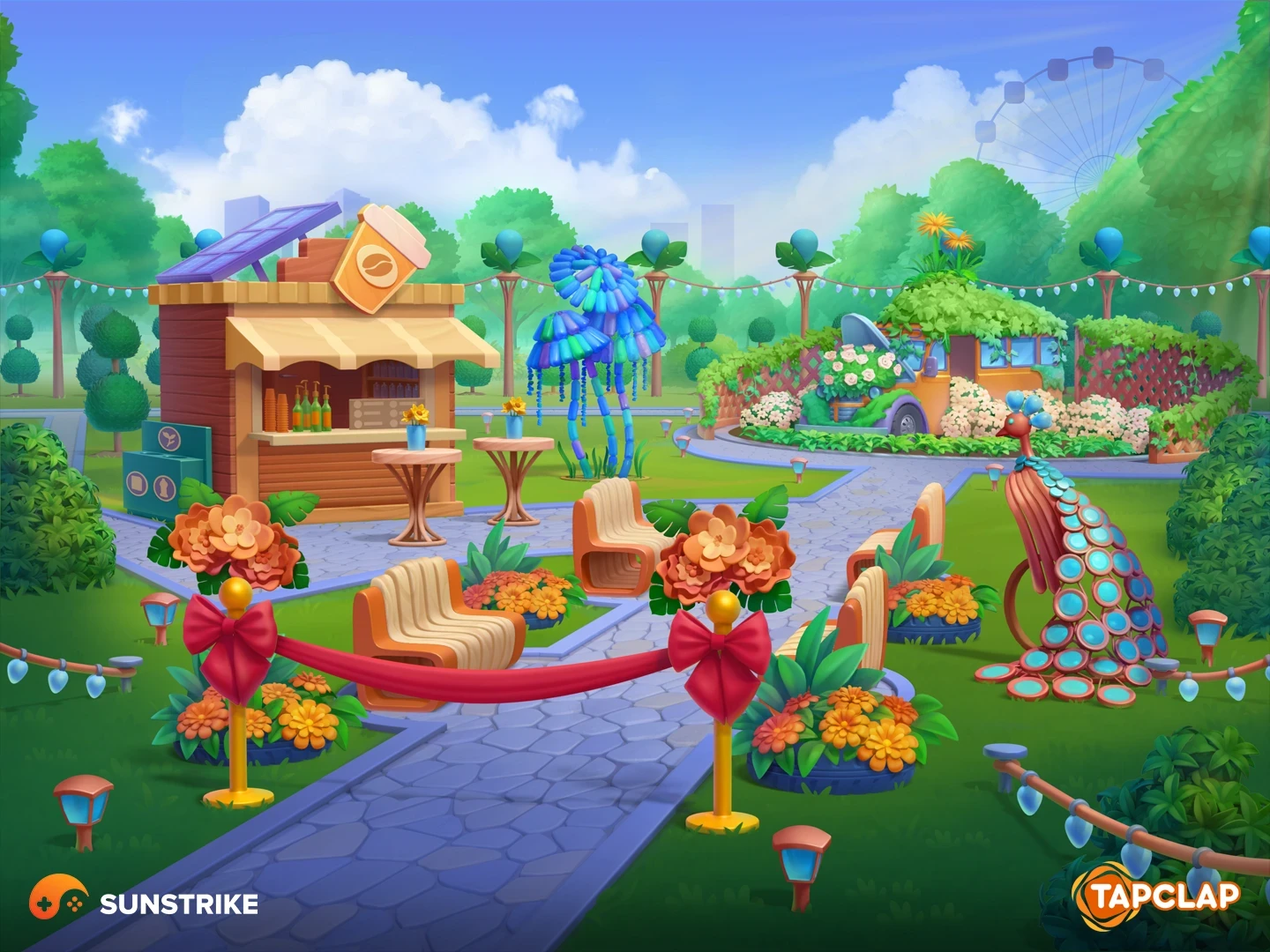
Merge games, city builders, and renovation titles treat the environment as progression content. Scenes ship together with object sets in several upgrade stages, so the player literally watches the background improve as they play. This format blurs into prop production: a garden background arrives with plant stands in three growth stages, tool racks, and furniture as separate placeable layers.
Loading screens and splash art
Technically illustrations rather than in-game layers, but produced by the same teams under the same style bible. They borrow marketing-art energy - stronger poses, higher contrast - because their job is anticipation, not readability under UI.
What Makes a Game Background Work
Three qualities separate production-grade background art from a nice painting.
Readability first. The player’s eye must land on gameplay in the first half-second. Backgrounds achieve that with value discipline: the busiest details live in corners and edges, contrast peaks are reserved for the play area, and saturation stays a step below hero objects. A quick squint test tells the truth - blur the scene and the play zone should still be obvious.
Camera and grid honesty. Every genre locks its own camera: a fixed top-down angle for match-3 boards, a strict isometric grid for builders, a horizontal stage for side-scrollers. A background painted off-grid fights the game forever - props will not snap, shadows will contradict objects, and every content update inherits the error. This is why professional pipelines start from the engine’s camera, not from a blank canvas.
Palette that serves the loop. Casual games run warm, inviting palettes with soft falloff so long sessions stay comfortable. The background’s colors are chosen after the gameplay objects’ colors, never before - the scene gets whatever contrast budget remains. For a deeper look at how style decisions start even earlier, see our breakdown of video game concept art.
How Studios Produce Backgrounds: the Pipeline
Mature teams run backgrounds through six gates, each with a review:
- Brief and references. Scene purpose, camera, safe zones, mood boards, and the style bible excerpt. Half of all rework traces back to a skipped brief.
- Composition sketch. Grayscale or rough color, checking silhouette flow and the quiet zone for gameplay. Cheap to redo - this is where directions are compared.
- Color key. Small color studies locking palette, light direction, and time of day before any detailing begins.
- Paint-over and detailing. The approved sketch is taken to final polish, with detail density controlled by zone.
- Integration check. The scene goes into the engine build: UI overlays on, board or objects placed, tested on small screens. Issues found here are still fixable in layers.
- Layered delivery. Final PSD with separated sky, midground, foreground, and effect groups, plus exports per the tech spec.
The same gates apply whether the scene is painted from scratch or over a 3D blockout. On isometric projects the blockout stage is heavier - geometry is modeled first, then rendered and painted over, which is how a city-builder art pipeline keeps hundreds of buildings consistent.
Layered Files, Reskins, and Live-Ops
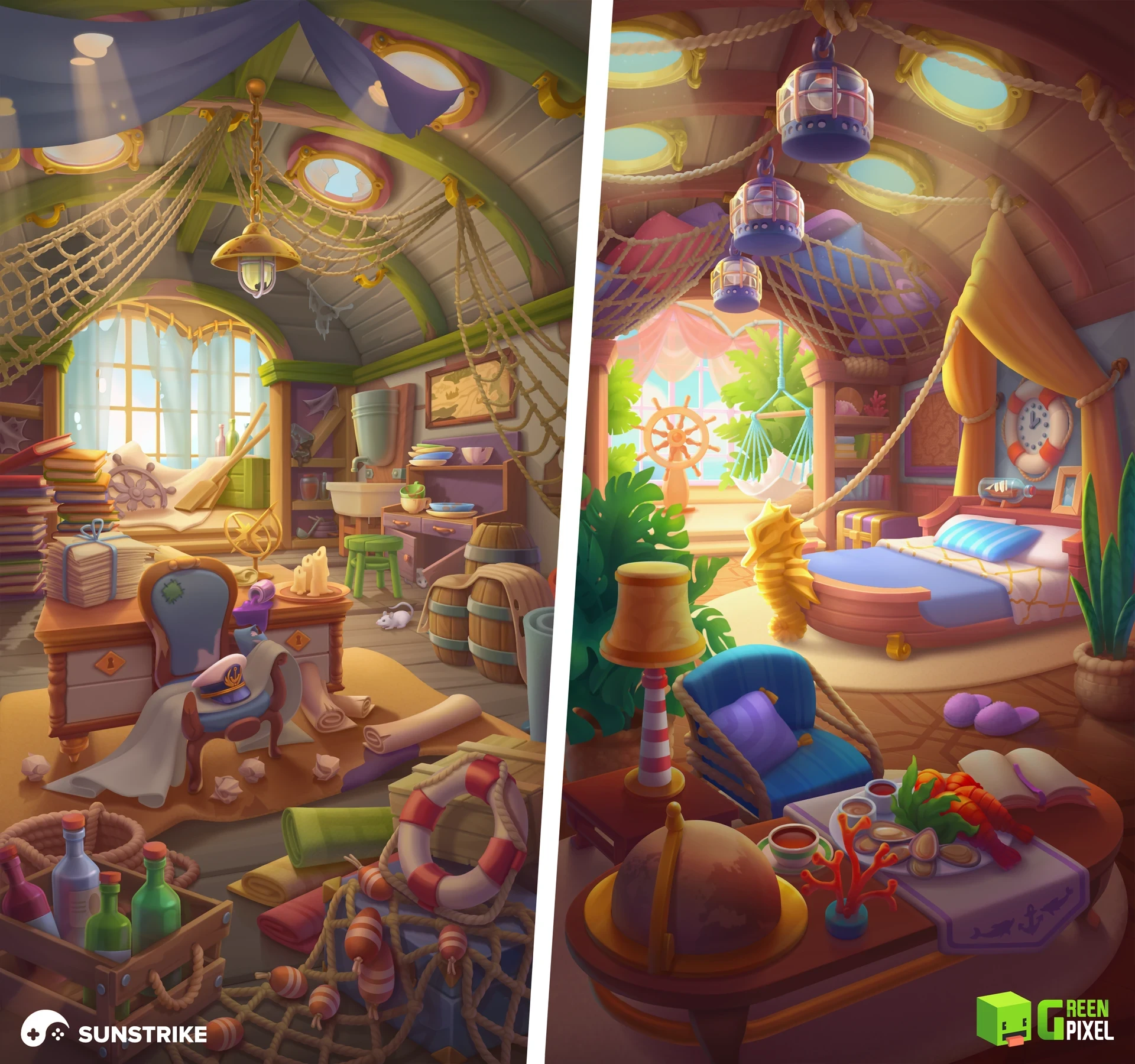
Live games do not order a background once. They redress it: winter event in December, blossom event in April, a horror pass for Halloween. The economics of that cadence depend entirely on how the original file was built.
A production-grade background ships as a layered file where sky, lighting, vegetation, and props sit in separate groups. A seasonal redress then costs a fraction of a new scene: recolor the light group, swap the vegetation layer, add themed props. On our long-running engagements - Playrix’s Fishdom sets, TapClap’s DesignVille scenes, Greenpixel’s Merge Hotel Empire rooms - this is exactly what keeps a live-ops backlog moving without rebuilding shipped art.
Background Styles by Genre
Casual and match-3: warm painterly rendering, soft shapes, lived-in props, saturation kept friendly for hour-long sessions. Merge and renovation: the same warmth plus strict stage discipline, because every object exists in upgrade tiers. Slots and iGaming: theatrical lighting and rich ornament - the background is allowed far more drama because sessions are short and the reel frame anchors the eye. Midcore and RPG: atmospheric depth, stronger value range, and lore-bearing details that reward inspection between fights. Slots are the tightest case of all, because the reel grid covers the middle of the screen and the composition has to survive it - a constraint we break down in the guide to slot game art.
The common thread: style is a genre contract with the player, not a personal preference. A background team’s real skill is switching contracts without quality loss.
Cost and Timeline Factors
Five variables drive the price of background art more than anything else:
- Detail density - a sparse sky-and-hills scene versus an interior with forty readable props.
- Resolution and aspect coverage - one phone ratio, or tablet plus desktop-safe extensions.
- Layering depth - flat export, standard groups, or full live-ops-ready separation with effect layers.
- Variants - time-of-day states, seasonal redresses, and progression stages multiply deliverables from one composition.
- Style match strictness - joining an established art bible costs calibration time on the first scenes; it disappears as the set grows.
As rough 2026 market anchors: a casual-quality 2D scene runs $300 to $1,500, hero locations and rendered isometric sets go higher, and per-scene prices drop meaningfully on batches of ten or more. Timeline: 3 to 7 working days per standard scene, with a calibrated team running several scenes in parallel.
In-House vs Outsourcing Background Art
An in-house background artist makes sense when environments are the core of your game and the backlog never dries up. For most studios, though, background demand comes in waves - a location pack for launch, then event redresses - which is precisely the load shape external teams absorb well.
A specialized partner brings the pipeline above ready-made: brief templates, style-calibration passes, layered delivery standards, and enough artist depth to parallelize a batch. If you are weighing that route, our 2D game art outsourcing page explains the engagement models, and the game background design services page shows how we structure background work specifically - from casual scenes to vertical maps and loading screens.
The Takeaway
Good video game backgrounds are engineered, not just painted: camera-honest, readability-first, delivered in layers that survive years of live-ops. Whether you build the capability in-house or bring in a partner, hold every scene to the same three questions. Does gameplay read instantly? Does the scene obey the camera? Will the file survive its tenth reskin?
Our team has answered those questions across hundreds of shipped scenes - from Solitaire Arcana’s gothic landscapes to Jewels of Egypt board frames and Homescapes garden sets. If your project needs that muscle, the portfolio speaks better than any guide: browse the background work and get in touch.